Day 9 - Fortresses and an Oasis of Calm

We left Split this morning and headed further North along the coast to Šibenik.
Šibenik is one of the oldest Croatian self-governing cities and, unlike the Greek-founded Dubrovnik and Split, was founded by Croats. In the 11th and 12th centuries Šibenik changed hands frequently between Venice, Byzantium and Hungary. This culminated in a three-year war where Venice reigned supreme and ruled here until the fall of the Republic of Venice in 1797 which brought Šibenik under the authority of the Habsburg monarchy.
As we entered Šibenik harbour we passed a fort which had taken over an island in the sea. This is one of the four fortresses that the Venetians built to protect Šibenik from the Ottomans, the St. Nicholas Fortress. The Ottoman Empire started threatening Šibenik nearing the end of the 15th century. The St. Nicholas Fortress was built in the 16th century on the island of Ljuljevac to prevent Turkish boats from reaching the port. The fortresses of St John and Šubićevac were built in the 17th century and joined the 11th century St. Michael’s Fortress and St. Nicholas Fortress in protecting the town from attack.
St. Nicholas Fortress
The St. Nicholas Fortress is included in UNESCO’s World Heritage Site list as part of the “Venetian Works of Defence between 15th and 17th centuries: Stato da Terra” which also included the fortifications at Kotor and Zadar.
When we arrived in Šibenik we had a walking tour of the town. This wasn’t as good as previous tours as the guide had a very dry delivery. After a short walk through the historic narrow streets we ended the tour at the Cathedral of St. James, a Cultural World Heritage site. Three architects succeeded one another in the construction of the Cathedral - Francesco di Giacomo, Georgius Mathei Dalmaticus and Niccolò di Giovanni Fiorentino. They developed a structure built entirely from stone and using unique construction techniques for the vaulting and the dome of the Cathedral. The form and the decorative elements of the Cathedral, such as a remarkable frieze decorated with 71 sculptured faces of men, women, and children, also illustrate the successful fusion of Gothic and Renaissance art.

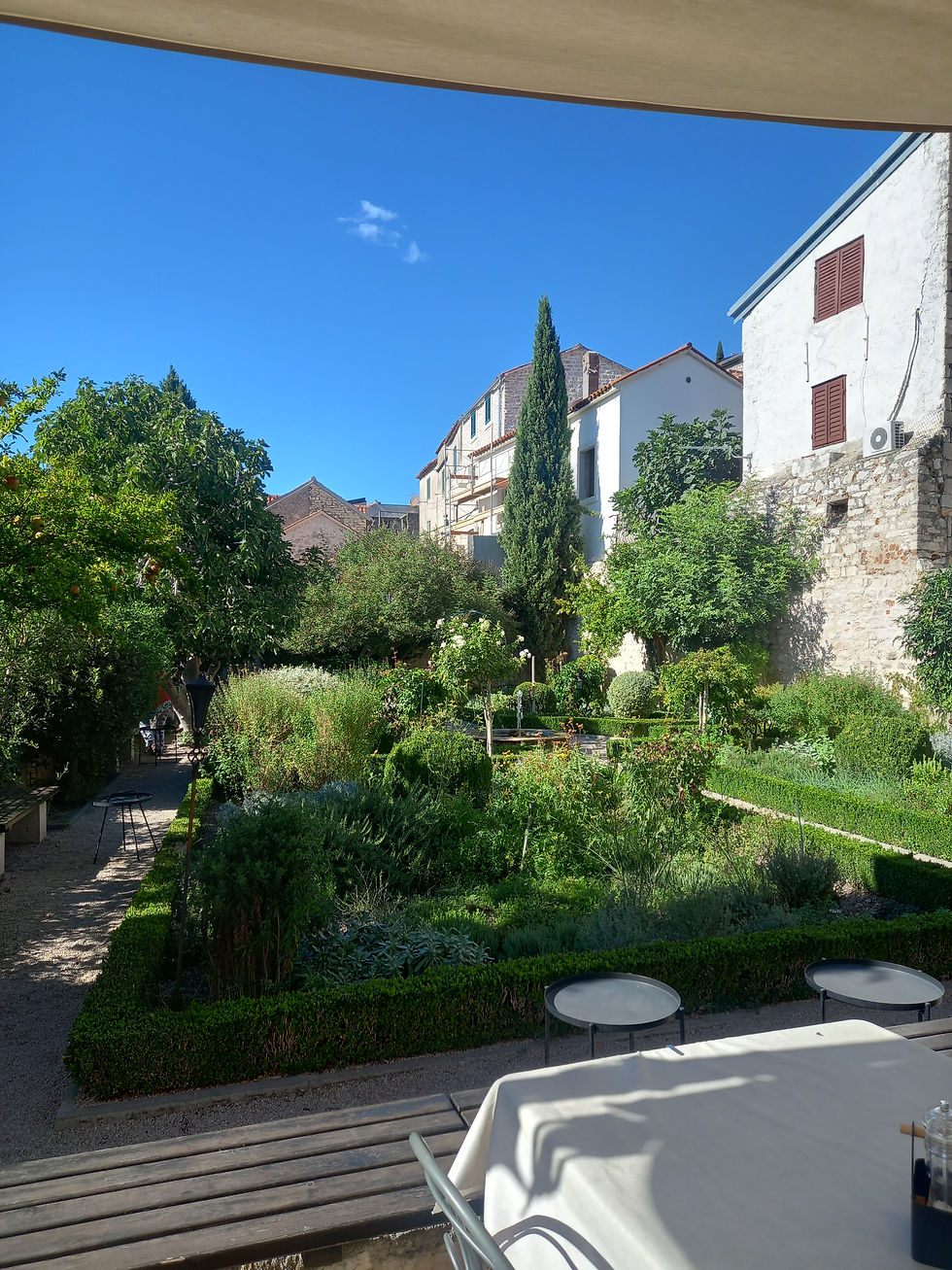
We had a little free time after the guided tour before our next excursion at 4:30pm. We had hoped to visit the 10th century St Michael’s Fortress up on the hill and to stop at the St Lawrence Monastery Gardens on the way. However, with the time constraint and after climbing many steps we decided it was far too hot to go as far as the fortress. So we stopped at the St Lawrence Monastery Gardens for coffee and crepes. It was a lovely peaceful and calming place. The garden was small but crowded with herbs and medicinal plants.
Tonight’s excursion is to the small village of Radosic. This is a family estate in the centre of which are about twenty old stone houses,12 of which have been completely renovated to the smallest detail in order to preserve the original form, respecting the tradition and architecture of the region. We were welcomed with a glass of grappa and some nice, warm, small doughnuts before being taken around the estate. We then had a traditional Croatian dinner of lamb and chicken. We had previously seen it being cooked, the lamb on a spit and the chicken in a clay pot with vegetables cooked under ash. It was yummy but far too much!
Our Traditional Croatian Dinner


Comments